
Article: The Meaning of Jewellery: Ancient Symbols to Modern Personal Expression

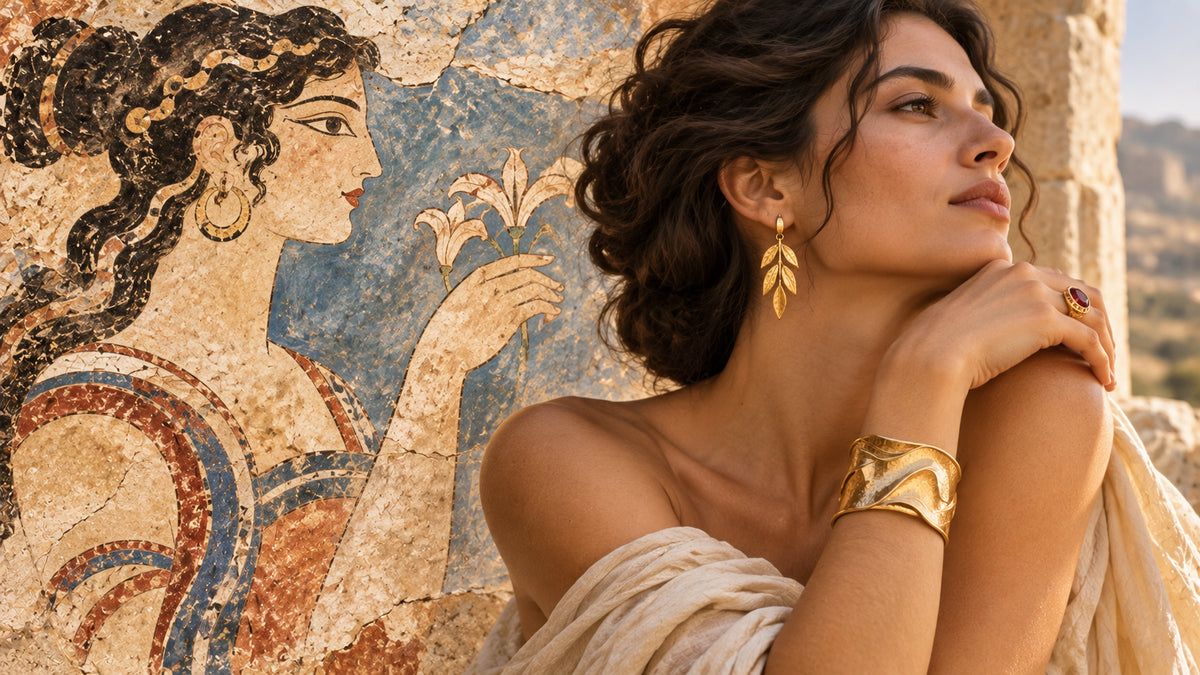
The Meaning of Jewellery: Ancient Symbols to Modern Personal Expression
An exploration of how jewellery has carried human beliefs, emotions and memories across thousands of years.
Long before jewellery became associated with fashion, luxury or personal style, it was already part of the human story.
A simple shell suspended from a cord, a golden amulet placed beside the dead, a ring engraved with a personal symbol — each could communicate something that words alone could not express.
Throughout history, jewellery has represented protection, authority, devotion, love, remembrance and belonging. Its materials have changed, its techniques have evolved, and its forms have followed the artistic traditions of different civilizations. Yet the human desire to give meaning to what we wear has remained remarkably constant.
To discover where this fascination began, we must travel back to a time before written history, when the first personal ornaments were created from shells, animal teeth, bones and naturally occurring stones.
Archaeological discoveries have revealed shell beads dating back more than 100,000 years, suggesting that personal adornment was already important to early human communities. These objects required deliberate selection and preparation, and sometimes materials were transported over considerable distances.
We cannot know precisely what every prehistoric ornament meant to its wearer. Yet such discoveries suggest that jewellery was already becoming a means of expressing identity, belonging and perhaps social relationships.
As societies developed and metalworking techniques emerged, personal adornment acquired increasingly elaborate forms. Gold, with its remarkable brilliance and resistance to corrosion, became one of the most desirable materials in the ancient world.
In Egypt, its enduring appearance helped establish an association with the divine, the sun and eternal existence. Jewellery was closely connected to religious belief, protection and the afterlife. Amulets depicting scarabs or the Eye of Horus accompanied both the living and the dead, while elaborate necklaces, bracelets and rings demonstrated the extraordinary abilities of Egyptian craftsmen.
Precious metals were often combined with colourful stones such as lapis lazuli, turquoise and carnelian. Their deep blues, greens and reds were admired not only for their beauty but also for the symbolic associations they carried. Colour could evoke the heavens, renewal, vitality or protection, giving an ornament a significance beyond its material value.
The use of such stones also reveals another fascinating aspect of ancient jewellery: its connection to distant lands.
In Mesopotamia, the magnificent gold ornaments discovered in the Royal Cemetery of Ur demonstrate how sophisticated jewellery making had become by the third millennium BCE. Gold was combined with lapis lazuli and carnelian, materials obtained through extensive networks of exchange.
A jewel could therefore represent far more than the wealth of its owner. It could embody the craftsmanship of one civilization, the natural resources of another and the journeys that connected them.
As these traditions spread and evolved around the Mediterranean, jewellery became increasingly intertwined with mythology, artistic expression and the natural world.
In ancient Greece, goldsmiths transformed precious metals into delicate wreaths of leaves, sculptural earrings, finely decorated rings and elaborate necklaces. Their work demonstrated an extraordinary understanding of proportion, movement and detail.
But Greek jewellery was not simply an exercise in beauty.
Its motifs frequently drew inspiration from the gods, sacred traditions and the natural environment. The owl, associated with Athena, evoked wisdom. The serpent appeared in mythology and religious imagery, sometimes connected with healing, protection or renewal. Laurel leaves recalled Apollo and the honour of victory, while olive branches carried associations with Athena and civic identity.
These symbols did not always possess a single fixed meaning. Their significance depended on the circumstances in which they appeared, the beliefs of the wearer and the traditions of the time.
Greek goldsmiths also incorporated gemstones and coloured materials into their creations. Garnets, amethysts, emeralds and other stones enriched the visual language of jewellery, while engraved gems could carry images of deities, animals or mythological figures.
The fascination with gemstones extended well beyond Greece. Across the ancient world, their rarity, colour and distant origins inspired admiration, while different cultures attributed symbolic or protective qualities to particular stones.
Even their names sometimes preserved traces of ancient beliefs. Amethyst, for example, takes its name from a Greek word meaning "not intoxicated", reflecting a traditional association with sobriety.
Such beliefs are part of the cultural history of gemstones rather than evidence of supernatural properties. What matters historically is the meaning people attached to these remarkable natural materials.
The relationship between jewellery and personal identity became particularly visible in ancient Rome.
Rings engraved with gemstones could serve as personal seals, authenticating documents or marking possessions. The image carved into a ring might depict a deity, an animal, a mythological figure or a symbol chosen by its owner.
Jewellery could reveal social position, personal taste, religious devotion and family connections. Gold, pearls, emeralds and other precious materials were admired for their beauty and rarity, but a simple engraved ring could possess an importance far greater than its monetary worth.
As the Roman world changed and Christianity became increasingly influential, jewellery gradually acquired new forms of religious expression.
In Byzantium, crosses, pendants and rings reflected the relationship between personal faith, artistic tradition and imperial culture. Goldsmiths combined precious metals with pearls and gemstones, creating objects whose richness of material often accompanied spiritual meaning.
Through the Middle Ages, jewellery continued to communicate devotion, authority and social identity. Religious symbols, inscriptions and heraldic motifs appeared on personal ornaments, while gemstones were sometimes believed to possess protective or medicinal qualities.
The passage of time did not erase earlier traditions. Instead, new beliefs and artistic styles were layered upon them, allowing familiar materials and forms to acquire different meanings.
The Renaissance brought renewed interest in classical antiquity, reviving an appreciation for engraved gemstones, mythological subjects and the artistic achievements of Greece and Rome.
At the same time, jewellery remained an important expression of wealth, political influence and social distinction in European courts.
Yet alongside magnificent ceremonial ornaments, a quieter and more intimate tradition continued to develop.
Jewellery increasingly became a way of preserving personal relationships.
Rings carried affectionate inscriptions. Pendants held miniature portraits. Lockets protected small keepsakes or locks of hair, allowing memories of loved ones to remain physically close.
By the Victorian era, sentimental jewellery had acquired a particularly elaborate language. Hearts, flowers, intertwined hands and other motifs could express affection, fidelity or remembrance. Mourning jewellery offered a tangible connection to those who had died.
The significance of a jewel was no longer measured only by the rarity of its materials or the skill required to create it.
A modest locket could become priceless because of the memory it contained.
Perhaps no form of jewellery illustrates this emotional transformation more clearly than the ring.
Across different cultures and historical periods, rings have represented authority, identity, relationships and commitment. Their circular form has often inspired interpretations of continuity and eternity.
Over centuries, wedding rings became one of the most recognizable expressions of personal devotion.
A simple band of gold could carry a promise that no gemstone or elaborate ornament was needed to explain.
And so, as jewellery entered the modern world, its symbolic language continued to evolve.
Advances in technology introduced new possibilities for design and production, while changing social customs influenced the way jewellery was worn and understood.
Diamonds, valued since antiquity for their exceptional hardness and rarity, became increasingly associated with romantic commitment through developments in cutting, fashion and modern marketing. Coloured gemstones continued to attract admirers for their natural beauty and personal associations.
Today, a sapphire may be chosen for its traditional connection with loyalty, a ruby for its association with passion, or a moonstone simply because its shifting light recalls a cherished memory.
The meaning of a gemstone is not always inherited from history. Sometimes it is created entirely by the person who wears it.
Contemporary jewellery offers extraordinary freedom of expression. Some pieces celebrate minimalism and architectural form, while others reinterpret ancient motifs or preserve traditional goldsmithing techniques.
A serpent ring may be admired for its sculptural elegance, its historical associations or its suggestion of renewal. An owl pendant may evoke the wisdom of Athena. A heart may represent romantic love, friendship, family or remembrance.
The same symbol can carry different meanings for different people.
And perhaps that is what makes jewellery so enduring.
Unlike many objects we own, jewellery is worn close to the body. It accompanies everyday life, important celebrations and deeply personal moments. It can be passed from one generation to another, preserving memories long after the circumstances in which it was created have disappeared.
An ancient gold ring, a family necklace and a contemporary handmade pendant may belong to entirely different worlds, yet they share a common human purpose.
They give visible form to something that cannot easily be seen.
In Greece, where the traditions of goldsmithing and symbolic ornament stretch back thousands of years, this relationship between history and contemporary craftsmanship remains especially meaningful. It is also a quiet source of inspiration for Dragatakis Jewellery, where ancient ideas find new expression through handmade design.
The forms may change.... the meanings remain....